Common Symptoms of IBD (Crohn's & Ulcerative Colitis)
Diarrhea, urgency, blood, fatigue, weight loss — the common symptoms of inflammatory bowel disease, how Crohn's and ulcerative colitis differ, and the warning signs that mean it's time to see a doctor.

If your gut has been acting up for weeks — not days — and you're starting to wonder whether it's more than a sensitive stomach, you're in the right place. This is a plain-language guide to the common symptoms of inflammatory bowel disease (IBD): what they feel like, what tends to point toward Crohn's disease versus ulcerative colitis, and the warning signs that mean it's time to see a doctor.
What are the common symptoms of IBD?
The most common symptoms of inflammatory bowel disease are persistent diarrhea, abdominal pain and cramping, an urgent need to have a bowel movement, blood in the stool, fatigue, and losing weight without trying. IBD is a chronic condition that flares and then settles, so these symptoms tend to come and go over time — flares can be separated by weeks, months, or even years — rather than clearing up in a day or two.
"On my worst day, I was rushing to the toilet 20 times a day. Sudden urgency left me with mere seconds to reach the toilet, disrupting every aspect of my life."
— Caroline E., living with IBD
That's one person's experience of a bad flare. Symptoms range from mild to severe and vary a lot from person to person, so your version may look very different. Here's what the common symptoms actually involve.
Common gut symptoms of IBD
Symptom | What it can feel like | Often linked to |
|---|---|---|
Persistent diarrhea | Loose, watery stools that recur for weeks; may contain blood or mucus | Both |
Abdominal pain & cramping | Crampy, often low in the belly, flaring suddenly | Both |
Bowel urgency | A sudden, can't-wait need to go | Ulcerative colitis |
Rectal bleeding | Blood in the stool or on the paper | Ulcerative colitis |
Mucus in stool | Slippery mucus passed with a bowel movement | Ulcerative colitis |
Tenesmus | Feeling you still need to go when the bowel is empty | Ulcerative colitis |
Nausea or vomiting | Queasiness, sometimes from narrowing in Crohn's | Crohn's |
Fatigue & weight loss | Deep tiredness; losing weight without trying | Both |
Diarrhea, urgency, and blood are the symptoms that most often send people to the doctor. In ulcerative colitis, easily-bleeding ulcers form on the lining of the colon, so blood — sometimes with mucus — is passed during bowel movements.
"Witnessing blood during bathroom visits was a stark indicator that something more serious than IBS was at play."
— Caroline E.
Abdominal pain in IBD is typically crampy and centered low in the belly, and it can flare suddenly.
"The excruciating stomach pains felt like internal stabbings."
— Caroline E.
Deep fatigue is one of the most underestimated symptoms — it's different from ordinary tiredness and can make everyday tasks feel exhausting, partly because ongoing inflammation and blood loss can lead to anemia.
Crohn's disease vs. ulcerative colitis
Crohn's disease can affect any part of the digestive tract, from the mouth to the anus, often in patches with healthy tissue in between. Because the inflammation can run deep through the bowel wall, Crohn's is more likely to cause strictures (narrowing), fistulas, mouth sores, and problems around the anus, alongside abdominal pain, often non-bloody diarrhea, and weight loss.
Ulcerative colitis is limited to the large intestine (colon) and rectum, where it causes continuous inflammation of the inner lining starting at the rectum. Its hallmark is bloody diarrhea, usually with urgency and tenesmus — the frustrating feeling that you still need to go even when nothing comes out.
The two overlap on diarrhea, abdominal pain, fatigue, and weight loss, and early on they can be hard to tell apart — only medical testing can confirm which one you have.
Symptoms beyond the gut
IBD is an inflammatory disease, so it doesn't always stay in the gut. Between a quarter and 40% of people with IBD develop symptoms elsewhere in the body, and these can sometimes show up before any digestive problems. The most common is joint pain or arthritis, which affects up to about 30% of patients; peripheral joint pain usually eases as gut inflammation settles, though spinal (axial) arthritis can follow its own course. Others include eye inflammation (uveitis), skin problems such as tender red bumps on the shins (erythema nodosum), mouth ulcers, and anemia — low red blood cells — which affects roughly one in three people with IBD. In children and teens, IBD can also slow growth and delay puberty.
"Mouth full of ulcers. Sore eyes. Sore joints."
— Caroline E., on her other symptoms
IBD vs. IBS: how they differ
It's easy to confuse IBD with irritable bowel syndrome (IBS) because some symptoms overlap, but they're very different conditions. IBS is a functional disorder — the bowel doesn't work smoothly, but there's no inflammation or lasting tissue damage, and nothing abnormal shows up when a doctor examines the colon. IBD involves real, visible inflammation that can damage the intestine over time and carries an increased risk of colon cancer. The features that point toward IBD rather than IBS are rectal bleeding, unintended weight loss, anemia, and fever — these aren't part of IBS and should always be checked out. If you're trying to make sense of your own pattern, our guide to what your poop is telling you is a good next read.
When should you see a doctor?
Ongoing gut symptoms don't automatically mean IBD, but they're worth investigating. Make an appointment with a doctor if you have:
Diarrhea lasting more than a week, or a change in your bowel habits lasting more than a few weeks
Belly pain that keeps coming back
Blood or mucus in your stool
Unexplained weight loss
Fatigue that doesn't lift
Seek emergency care if you have severe abdominal pain, non-stop bleeding from your bottom, so much blood that the toilet water turns red or you see large clots, or you're vomiting blood or what looks like coffee grounds.
Track your symptoms before your appointment
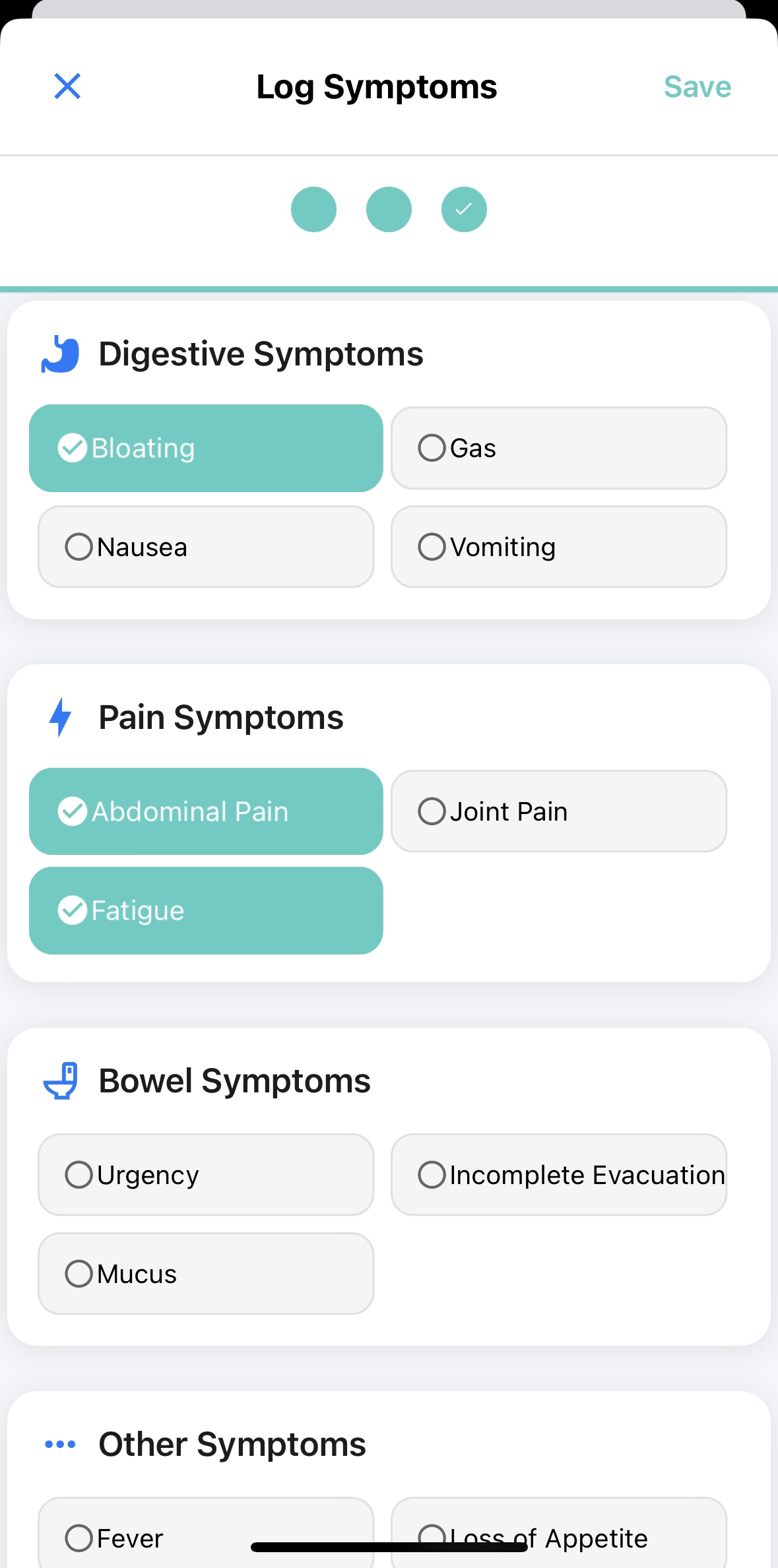
Because IBD symptoms flare and fade, a few weeks of notes are worth more than trying to remember everything in the exam room. Logging stool type and frequency, urgency, blood, pain, food, and fatigue gives your doctor a clear pattern to work from. FlareCare lets you record bowel movements with the Bristol Stool Scale, symptoms, and food, then turn it into a report for your appointment. If you think your symptoms might be starting, our piece on early signs of IBD covers when to act.
Frequently Asked Questions
What is usually the first sign of IBD?
There's no single first sign, but persistent diarrhea, crampy abdominal pain, urgency, or blood in the stool are common early symptoms. Because IBD flares and settles, the giveaway is symptoms that keep coming back over weeks rather than clearing up quickly.
Can IBD cause symptoms outside the gut?
Yes. Up to 40% of people with IBD have symptoms beyond the digestive tract — most often joint pain, plus eye inflammation, skin changes, mouth ulcers, fatigue, and anemia. These can sometimes appear before any gut symptoms.
Is IBD the same as IBS?
No. IBS is a functional disorder with no inflammation or tissue damage, while IBD causes visible inflammation that can harm the intestine. Rectal bleeding, weight loss, anemia, and fever point toward IBD, not IBS.
At what age does IBD usually start?
Most people with IBD are diagnosed before age 30, though it can begin later, including in your 50s or 60s. It can affect children, teens, and adults.
Can you have IBD without a family history?
Yes. Only about 5 to 20% of people with IBD have a first-degree relative who also has it, so many people are diagnosed with no family history at all. A family history does raise your risk, but it isn't required.
Sources: this article draws on patient-education materials from the Crohn's & Colitis Foundation, NIDDK (NIH), the Mayo Clinic, the NHS, and the CDC. It's for general education, not medical advice — please talk to a healthcare professional about your own symptoms.
Turn this into your own data.
Reading about gut health helps. Tracking your own patterns — meals, symptoms, bowel movements — is what actually shows you what's going on.

Stay Updated
Get the latest gut health tips and research delivered straight to your inbox.
By subscribing, you agree to receive our newsletter. You can unsubscribe at any time.
Keep reading
Symptoms
Early Signs of IBD: Symptoms, When to See a Doctor & How It's Diagnosed
The early signs of IBD are easy to miss because they come and go. Here's what to watch for, when to see a doctor, and how Crohn's and ulcerative colitis are diagnosed.
Read
What Your Doctor Wishes You Logged Before an Appointment
Preparing for a gastroenterology appointment can feel overwhelming — especially when you’re living with IBD or IBS. The good news? A few simple logs can make your visit more productive. From bowel habits to food triggers, stress, and meds, here’s exactly what your doctor wishes you tracked — and how FlareCare makes it easy.
Read
FlareCare
The Gut Health Tracker You Didn’t Know You Needed: How FlareCare Helps You Manage IBD, IBS, and Chronic Digestive Symptoms
Tired of guessing what’s triggering your gut issues? FlareCare is an all-in-one symptom tracker built for IBD, IBS, and anyone with digestive struggles. With AI-powered insights and easy logging tools, you can finally connect the dots and take control of your gut health.
Read